Your Self-Help Weapon: The Humble Foot Bath

If I told you there was a wellness practice that costs almost nothing, takes fifteen minutes, has been used for over two thousand years, and can help with everything from insomnia to cold hands and tired legs — you’d probably ask why we ever stopped doing it.
In Traditional Chinese Medicine (TCM), the evening foot bath isn’t a spa indulgence. It’s a self-help weapon — a quiet, daily ritual that nourishes the body from the ground up. Long before we had pharmacies and supplements, our ancestors were soaking their feet to defend against illness, calm the spirit, and keep the qi flowing.
Let’s talk about why this practice has survived for so long, and how to do it properly at home.
Why the Feet? The TCM View
To Western eyes, the feet are just feet — the part of the body furthest from the heart, the part we tend to ignore until something hurts. In TCM, the feet are something else entirely: a map of the body.
Six of the body’s twelve main meridians (经络) begin or end in the feet. The three yin meridians of the foot — spleen, liver, and kidney — originate in the toes and travel upward into the torso. The three yang meridians — stomach, gallbladder, and bladder — descend through the leg and terminate at the foot. Stimulating the feet, then, is like pressing a button connected to nearly every major organ system.
The most famous point of all sits right on the sole: Yongquan (涌泉), or “Bubbling Spring,” the first point of the Kidney meridian. It is one of the few acupoints on the very bottom of the foot, and it is considered a gateway for grounding excess heat, calming the mind, and tonifying kidney essence (肾精) — the foundational energy that, in TCM, governs aging, vitality, and reproductive health.
So when you soak your feet, you’re not just warming your toes. You’re sending heat, circulation, and gentle stimulation up through the entire meridian system.
The Ancient Wisdom
Foot bathing has deep roots in Chinese classical medicine. The Huangdi Neijing (《黄帝内经》, The Yellow Emperor’s Inner Canon), compiled over two thousand years ago and still the foundational text of TCM, observed that:
“寒从脚下生,病从寒中来。”
“Cold arises from beneath the feet, and illness arises from cold.”
This is the core diagnostic insight: the feet, being far from the heart and close to the ground, are the body’s most vulnerable entry point for cold pathogens (寒邪). Keep the feet warm, and you fortify the body’s defenses.
A traditional folk verse, often attributed to Qing dynasty health manuals, captures the seasonal logic of foot bathing beautifully:
春天洗脚,升阳固脱;
夏天洗脚,暑湿可祛;
秋天洗脚,肺润肠濡;
冬天洗脚,丹田温灼。
In spring, wash the feet to lift yang and anchor what is loose.
In summer, wash the feet to dispel heat and dampness.
In autumn, wash the feet to moisten the lungs and intestines.
In winter, wash the feet to warm the dantian (lower abdomen).
The Benefits
From a TCM perspective, a regular foot bath can:
Improve sleep. The descent of yang energy at night is what allows us to rest. A warm foot bath draws excess heat away from the head and chest down to the feet, helping the mind settle. Many people find a 15-minute soak before bed more effective than melatonin.
Warm cold extremities. If you have perpetually cold hands and feet, TCM would say your yang qi isn’t reaching the periphery. Foot baths physically and energetically push warmth outward.
Relieve fatigue and heavy legs. After a long day standing or walking, soaking the feet promotes circulation, reduces swelling, and dissolves the stagnant qi that builds up in the lower body.
Support the kidneys. In TCM, the kidneys govern bones, hearing, hair, and the basic life force. Stimulating the Yongquan point and warming the kidney meridian is considered tonifying — especially valuable as we age.
Dispel dampness. People with sluggish digestion, brain fog, or that “heavy” feeling TCM calls dampness (湿气) often benefit from foot baths with warming herbs like ginger or mugwort.
Calm the spirit (安神). The ritual itself — sitting quietly, water on skin, no phone — is a small, contained meditation. The shen (spirit) settles when the body is grounded.
How to Do It Properly
The mechanics are simple, but the details matter.
Water temperature: 38–43°C (100–110°F). Hot enough to feel warm and slightly stimulating, but not so hot it scalds. If you have diabetes or reduced sensation in your feet, use a thermometer — don’t trust your skin.
Water level: above the ankles, ideally up to mid-calf. The Sanyinjiao point (三阴交), where the three yin meridians meet, sits about four finger-widths above the inner ankle bone. Submerging it deepens the effect.
Duration: 15–30 minutes. You want to soak long enough to break a light sweat on the forehead or back. That’s the signal that yang qi has begun circulating. Don’t push past sweating heavily — that depletes rather than tonifies.
Best time: 9–11 PM. This is the sanjiao (triple burner) meridian’s active window in the TCM body clock, and the hour when winding down for sleep is most natural. Avoid soaking immediately after a meal — wait at least an hour, since heat draws blood to the feet and away from digestion.
Vessel: a deep wooden bucket if you can. Plastic basins work fine. The traditional choice is wood (often cedar or fir) because it retains heat well and doesn’t conduct cold from the floor.
After: dry thoroughly and massage Yongquan. Press and rub the depression in the center of each sole, just below the ball of the foot, for one or two minutes. Then put on warm socks and head straight to bed if it’s evening.
Herbs to Add
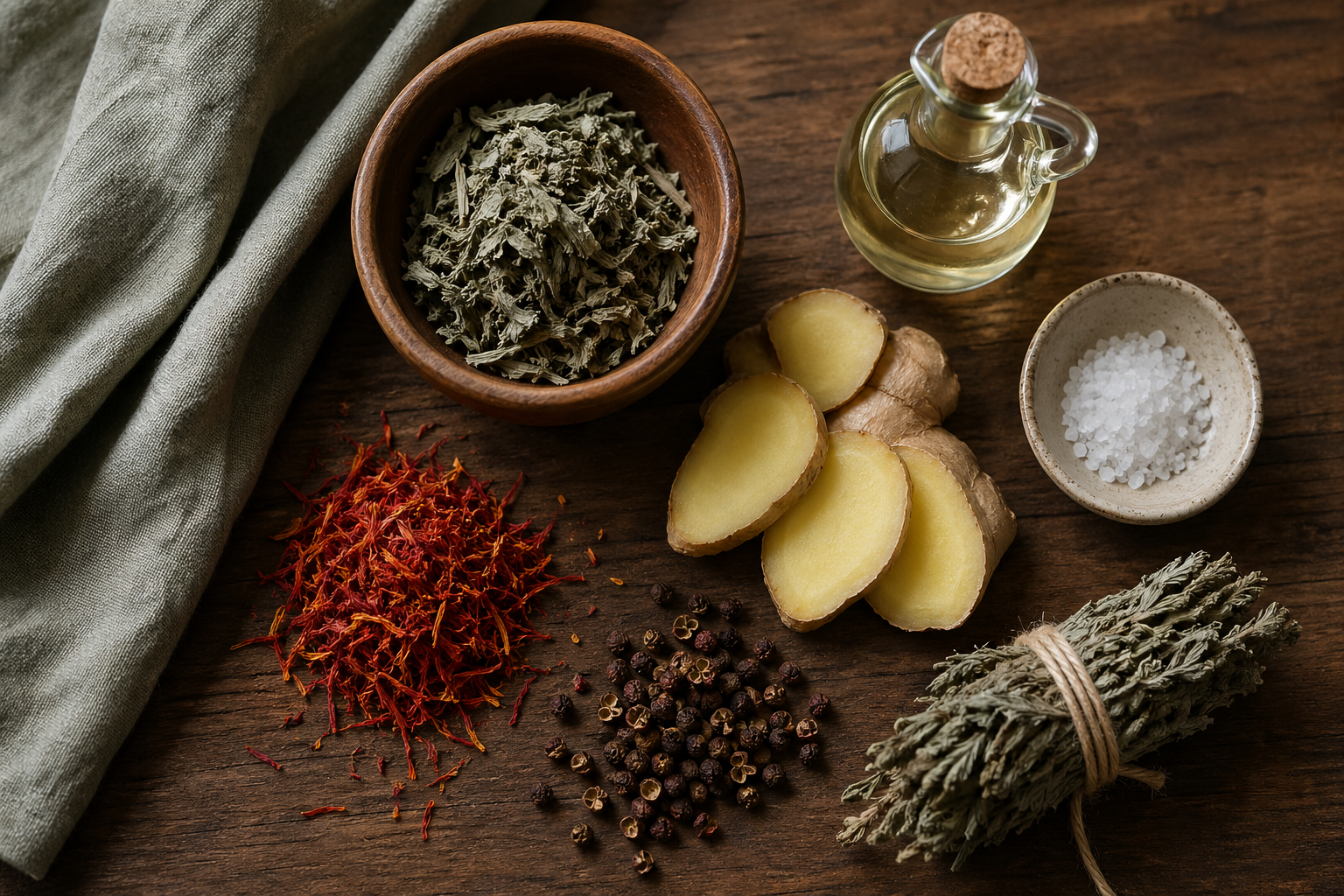
This is where foot bathing becomes personalized medicine. A few classics:
Ginger (生姜) — for cold hands and feet, sluggish digestion, or feeling chilled to the bone. Crush 4–5 thick slices and simmer briefly before adding to the bath.
Mugwort / Ai ye (艾叶) — perhaps the most beloved foot bath herb. Warming, dispels cold and dampness, supports the meridians. A small handful, simmered for 10 minutes.
Safflower / Hong hua (红花) — for circulation, especially if you have varicose veins, menstrual stagnation, or that heavy-leg feeling.
Sichuan pepper / Hua jiao (花椒) — strongly warming, antifungal, good for cold-related foot conditions.
Epsom salt or coarse sea salt — not classical TCM, but pairs well with most herbs and helps draw out fatigue.
Vinegar — a splash of rice vinegar softens skin and is traditionally used for foot odor and fungal issues.
A Few Cautions
Don’t soak your feet if you have open wounds, severe varicose veins with active inflammation, or untreated foot infections. People with diabetes should be especially careful with water temperature. Pregnant women should avoid safflower and certain other herbs that move blood strongly — plain warm water is fine. Anyone with a heart condition should keep sessions shorter (10–15 minutes) and the temperature moderate, since long hot soaks can drop blood pressure. Skip it when under the weather.
If you start foot bathing and notice unusual symptoms — palpitations, dizziness, profuse sweating — that’s the sign to stop and reassess.
The Quiet Power of Small Rituals
What I love about the foot bath is how unremarkable it looks from the outside. A bucket of warm water. A handful of herbs. Fifteen minutes. Nothing to buy, nothing to schedule, no app to download.
And yet it works. It works because it respects something modern wellness often forgets: that the body responds to consistency more than to intensity. A daily fifteen-minute soak, done for a season, will do more for your sleep and circulation than a single expensive treatment ever could.
Two thousand years of physicians, poets, and grandmothers can’t all be wrong. Tonight, fill the bucket. Sit down. Let the steam rise. This is the self-help weapon they’ve been recommending all along.
Consistency beats intensity — that's true of the foot bath, and it's true of everything I do in the treatment room. If you'd like help building the rest of it, here's how I work.